Manufacturer: SMART MEMORIES Sp. z o.o.
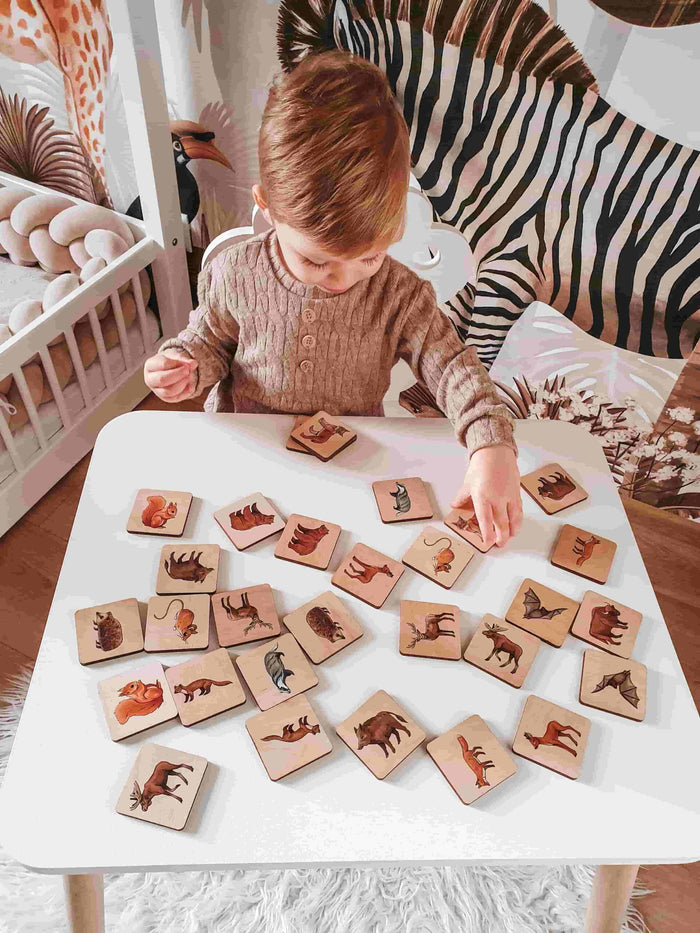
Birds of Europe is an educational game consisting of 15 pairs of wooden memory tiles featuring our original illustrations. The depicted species include well-known ones like the pheasant and the black-headed gull, less common ones like the European roller and the hoopoe, as well as those living on distant islands, such as the Atlantic puffin.
Forest education in your own home? Why not?! The memory tiles are complemented by educational cards, which contain the most important facts about each animal. Did you know that the goldcrest is the smallest bird in Europe, and the peregrine falcon is the fastest bird in the world? It is time to discover the fascinating world of birds and observe the species we present in their natural habitat.
Supporting a child’s development through play, as encouraged by the Montessori method, allows for the acquisition of knowledge in a given field as well as training necessary skills. Social and linguistic competencies, as well as the ability to learn, are very important for every little one. How can you play wisely with a child? You will find answers to this question in 5 suggested play scenarios included with our memory tiles. When creating the game suggestions, we tried to ensure that the toy grows with the child, making it attractive both for a 3-year-old and for school-aged children. Some scenarios make use of the educational cards.
A memory game primarily helps to shape: concentration, memory, visual perception, eye-hand coordination, as well as speech and communication. Did you know that:
- Concentration is the ability to focus attention on something specific. It can be an activity being performed, a specific object, or instructions given by a teacher. Attentional focus ensures proper child development and is essential at every stage of education.
- A young child’s mind is like a sponge. Toddlers quickly absorb a great many new words and pieces of information, which allows them to get to know their surrounding environment. For this process to proceed without disruption, continuous memory training is necessary.
- Visual perception allows a child to get to know and understand the world around them, and is also essential in further education for learning to read, write, and count. Initially, when playing with several elements with different pictures, a child must focus their vision on them and evaluate what they see, e.g., colors, shapes, similarities, and differences. This is an introduction to more advanced analysis, which is, among other things, the foundation of logical thinking.
- Eye-hand coordination enables precision of movement. It is essential in daily activities – from eating independently, getting dressed, drawing, or writing, to physical activity. Eye-hand coordination additionally requires training the child’s hands and fingers, i.e., fine motor skills.
- Speech and effective communication are the basis of daily life in the family and are also indispensable in developing social competencies. They allow a child to express their thoughts and feelings and to understand what others wish to convey.
Play suggestion
Animals come in pairs: learning bird names – number of players: 2-4, suggested age: 3+
The goal of the game is to learn and memorize the names of the birds found in Europe that are depicted on our memory tiles. The first step is to carefully look at the animal cards, try to remember their names, and their characteristic features (e.g., black and white stripes on the wings and a characteristic crest on the head of the hoopoe). Next, the memory tiles should be turned face-up, mixed, and spread out in any way. In a set order, players give each other tasks consisting of finding 2 specific animals (e.g., the person starting the game gives a task to the person sitting on the left to find a pheasant and a northern lapwing). The player who has found the tiles with the sought-after birds places them next to each other and then indicates to the next person which animals they need to find (note: when giving a task to search for specific animals, choose only those that have not yet been taken). These same actions are repeated by subsequent players until all the elements are finished. In this version of the game, everyone wins, regardless of the number of birds collected.
Tips:
- the game can be modified by setting tasks to find a pair of a specific animal (e.g., a player searches for 2 cranes) or by searching for two different animals (as in the version described above);
- the difficulty level of the game can be adjusted depending on the number of pairs used in a given session; it is possible to use all 30 elements, or 15 (in which case a given bird will appear in the game only once);
- the game can be modified by introducing tasks to find a different number of animals, e.g., the player searches for only 1 bird per turn;
- the game can be made more attractive by introducing a rule of turn priority, e.g., the game is started by the person who last saw a bird; this person tells a story about the encounter (e.g., what the bird looked like, where and when it was observed).
You will find more play suggestions in the booklet included with the toy and on our Facebook and Instagram fan pages.
Wooden memory game with learning cards — Birds of Europe
Availability
In stock
Delivery time
1 business day
Free shipping
Check at checkout
Skills developed:
You may also like
-

-
-
 Sale
Sale
Wooden dinosaur figures
€14.90€29.90 -
 Sale
Sale
Two-piece wooden puzzles — Vegetables
€15.90€19.90 -
Hanging baby cradle — heather
€119.00€199.00


